My doctor’s face turned to one of curiosity as she peppered my patella tendon with platelet-rich plasma while looking at the ultrasound screen.
“Interesting,” when someone has a very large needle stuck into a very sensitive spot in your body, is not exactly the word you want to hear.
That PRP was this past December, aimed at helping to heal my extremely angry patella tendon and a slow-healing inferior pole patella fracture sustained during a very dumb and klutzy fall at High Lonesome 100 the previous July. Inferior pole fractures are notoriously slow to heal, and I had also “hemorrhaging” through my patella tendon (thanks MRI report!). Yet, 6 months in, things seemed to be getting worse despite “doing all the right things.”
What we found during that PRP, which was later confirmed via MRI, was that a piece of my patella had avulsed from the bone at some point in those 6 months and was now hanging out in a very inconvenient spot around the tendon and the fat pad.
Nothing like spending $2k on PRP to learn mid-procedure that it likely wasn’t going to anything for you unless it magically had properties to reattach bone fragments (news flash: it doesn’t).
After consulting with multiple surgeons in the winter, it seemed the consensus was that for me to get back to running, that fragment was going to have to come out. I’m not going to lie, there was a part of me that was relieved when I finally had an answer to why this injury refused to get better after the initial fracture had healed, and also why it presented so oddly. For example, unlike most people with patella tendinosis, I had zero pain going down stairs but extreme pain when going up stairs. No pain when walking downhill but I couldn’t hike up a steep hill or squat up off the toilet without sharp pain. And it was always localized in one spot on the outer edge of the kneecap.
At that point in February I had gone through a few aborted return to run attempts over the past few months. Running had never hurt during but my knee always got super hot and stiff and swollen post-run, which my doc and PT took as a sign to stop. I never got much past one min jog/one min walks.
Surgery at that point would seem like the obvious choice, right? Perhaps.
I left the surgeon’s office that day asking him if I could try another return to run. He said absolutely yes - there’s always the possibility that the body could adapt to that fragment and it may not cause issues (though he was about 99% positive it would end up causing issues as I attempted to increase mileage and get back to the level of running that I wanted to do).
Welp, he was right. Though I made it much further in my running than I thought (and probably he thought!) I would. But it is a weird thing to go into surgery when the thing you want to get back to doing is something that actually doesn’t cause much pain during (just after). The hypothesis was that the fragment irritates mainly at certain degrees of flexion, which I don’t typically get while running unless I’m running up a steep hill. Or squatting to parallel. Or trying to do a high right knee while climbing. Or going up stairs. Or getting off the toilet. Or standing for a long period of time. Or extending my leg fully straight. While the PRP actually did end up helping the tendon, the fragment was rubbing and irritating the tendon and the fat pad constantly, resulting in just a consistent level of mechanical inflammation. No amount of strengthening, PT, rest, ice, PRP, shockwave, or whatever else I could try would help with that.
So it hurt…a lot more than I cared to admit. And I rationalized the whole “but it’s fine while running” to avoid the inevitable. I will admit that it was a fun few months of burying my head in the sand, but there comes a point where the joy of a pain-free run isn’t worth the hobbling around in pain for 24 hours after.

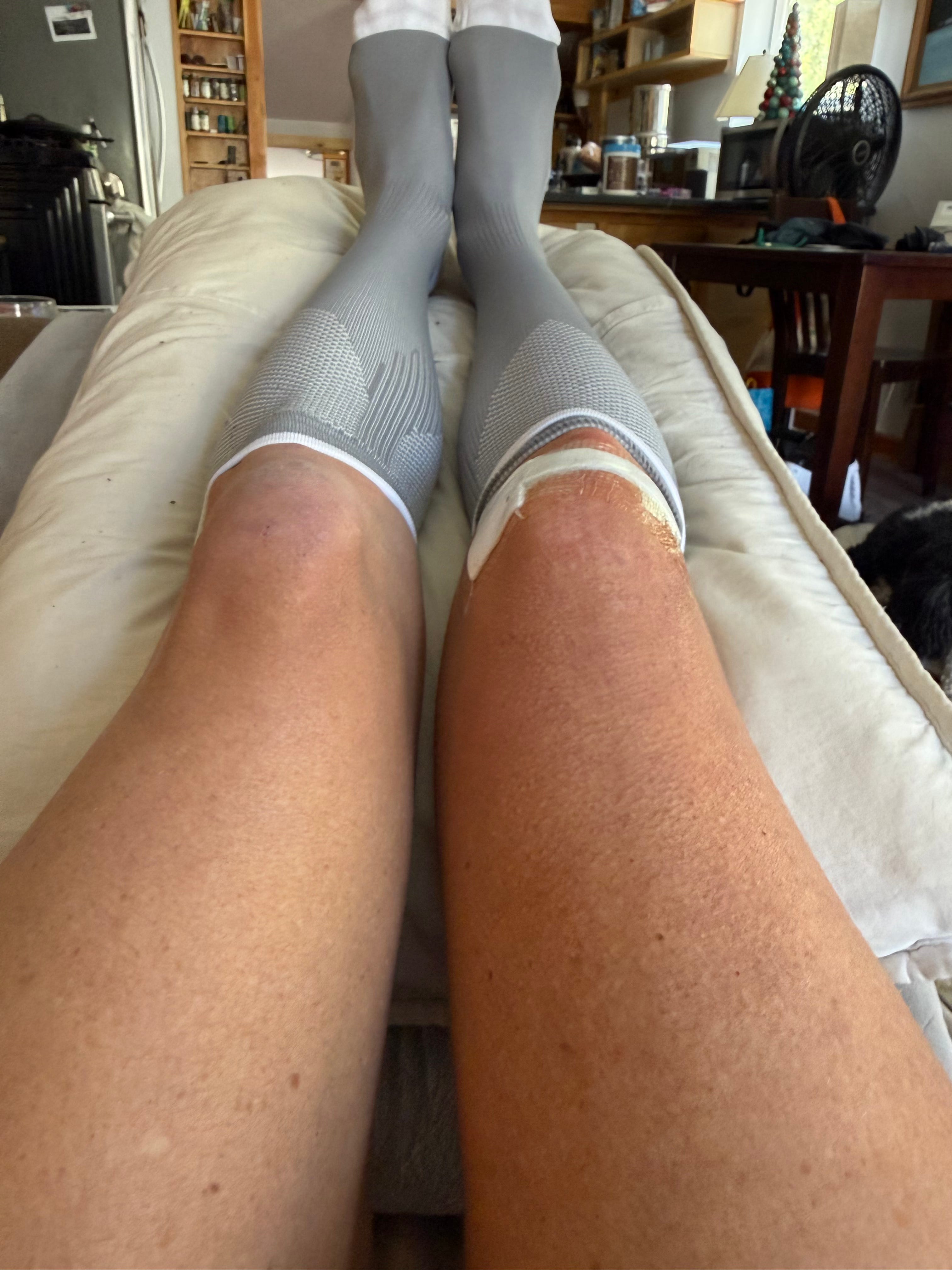
While I hope this surgery brings the whole knee saga to a close, it’s going to take me several weeks or months to figure that out as I move through the rest, recovery, rehab, and return to run process. I suppose these are the calculated risks we take when we decide upon an elective surgery: this could fix the problem, it could stay the same, or, there’s always the possibility it ends up worse.
My brain is the type that will fixate on that last option, which is probably what kept me postponing surgery for so long. It’s funny how quickly we can normalize pain - the devil that you know is always way less scary than the one you don’t. And what’s on the other side of this surgical rehab is a whole lotta unknown.
But [they tell me that] I’m still young, and that if I have a shot to have a pain-free knee, figured it was time to take it. Let’s go, knee. If anything, I’m super stoked to not one-legged squat up off the toilet anymore.
Thanks for reading Race Ipsa Loquitur! Subscribe for my sagas.