In 2014, I did something extraordinary dumb. 8 weeks after a knee arthroscopy, I ran (and won) World’s Toughest Mudder, securing a second obstacle racing world championship. And instead of being lambasted for a pretty reckless decision, I was praised. Congratulated for being super human. Added a feather in the cap to being the Queen of Pain.
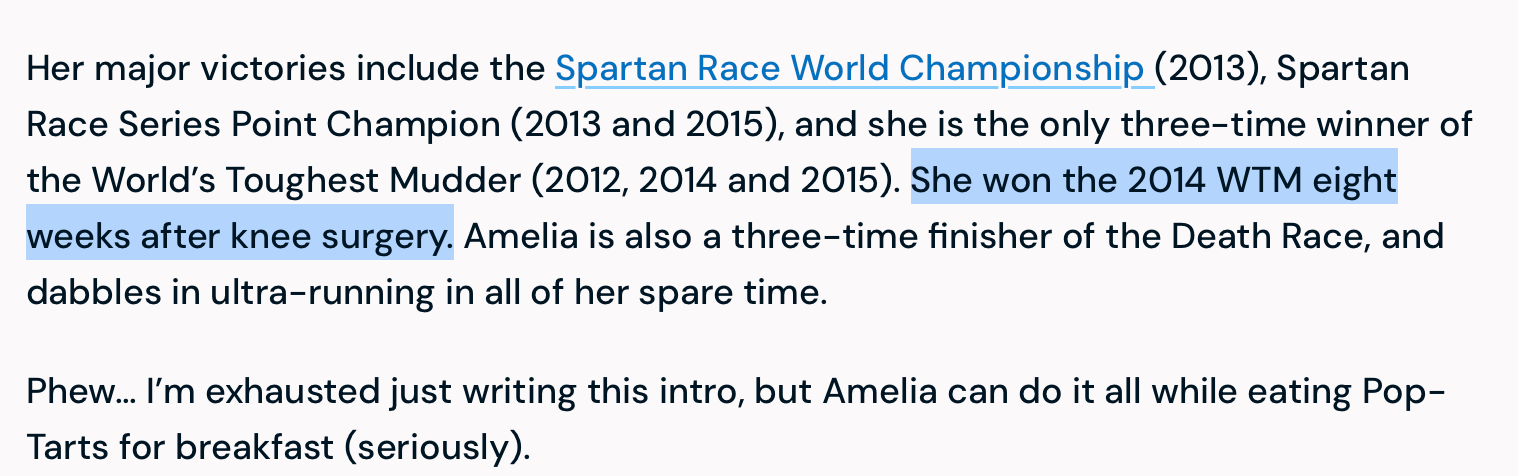 A podcast intro from 2015. This similar intro was used throughout media at the time.I don’t really remember a medical professional at the time telling me I _shouldn’t _run a 24-hour race 8 weeks post-op, but I have to imagine at least one did. My recovery went extraordinarily well, likely because what they did in there was super minimal1. I started back running one month post-op and promised myself that if I hurt during the race, I’d stop. Shockingly, it never did (and I’ve never had an issue with that knee since). Also not shockingly, I did end up tearing my opposite glute med and hip flexor somewhere during race, likely from compensating.
That part was really never reported.
The lasting effect of entire escapade, however, was not the left knee or the torn glute med or the brief bump in “fame” I received - it’s that, whether or not I like to admit it, I probably had unrealistic expectations going into this recent knee surgery.
While this was a “knee scope”, it was a bit more invasive than your typical knee scope - shaving down/extracting a 1cm wide portion of the inferior patella pole where a fragment had avulsed, debriding some fibrotic fat pad where that fragment had been pinching and causing pain, and putting a metric ton crapload of PRP into the tear in the proximal patella tendon.2 Given it’s a rather uncommon surgery, they estimated 6-8 weeks until I could try running again. Before surgery, I reminded myself “remember that surgeons tend to overpromise aggressive timelines so don’t be disappointed if it’s longer.” Clearly that sage thinking has gone out the window as I count the days and running seems nowhere close.3
So as I still hobble around at 3.5 weeks post-op and my knee is snapping and clicking and more painful than before surgery, it’s hard for my brain to not jump to “WHAT HAVE YOU DONE TO YOURSELF - WHAT IF THIS ENDS UP WORSE THAN BEFORE.”
Perhaps this is a natural phenomenon in any elective surgery (please tell me I’m not alone in this!), but mine is aggravated by my good old friend, obsessive-compulsive disorder. My OCD manifests in a variety of ways, but one of those ways is utter paralysis and indecision out of fear of “making the wrong choice.” It’s why I canceled this surgery once before. It’s why I sought out probably way too many medical opinions. It’s the voice that kept searching for the “perfect” decision and “perfect” time to have surgery even though I logically know there is no such thing.
And it’s the voice that yaps in my head right now that treats assumptions as facts and overestimates the possibilities of bad things happening: what if I just destroyed my knee forever?
The cruelest part about OCD is the perpetual illusion that I am 100% in control of how quickly I heal and get back to running and climbing. If it takes longer than I think it should, it’s my fault and I did something wrong. I didn’t ice enough, I didn’t elevate enough, I didn’t start compression soon enough, I didn’t do enough quad sets, I did too many quad sets, I iced too much, I didn’t eat enough anti-inflammatory foods, I didn’t get in enough protein, I walked too much, I didn’t walk enough.
It’s exhausting and there is absolutely zero way to win.
My work right now is to stop trying to win that unwinnable game, and accept that my body will heal on its own timeframe. While there are certainly things I can do to help aid in that (or dumb things I can avoid doing to not stymie that), it is not fully within my control. Every recovery is different, sometimes for reasons we can’t explain. It’s not a moral failing if it takes longer than standard timelines suggest, and I don’t deserve praise if my recovery is quicker than anticipated.
While I’ve had (way too) many injuries in my life, this knee saga has been the first time that healing didn’t “go to plan.” All of my stress fractures healed well within the timelines doctors gave me, and I’ve never had residual issues. Those experiences have perhaps given me a false sense of control over my body’s healing capabilities. Or perhaps, traumatic fractures with tendon involvement don’t follow the simplicity of “unload it on crutches and wait” that I’m used to with prior bone injuries.
I hate it.
Knee are dumb.
Shit happens for reasons beyond our control.
And none of that makes me feel better but sometimes it just feels good to say out loud as a reminder to myself. Maybe if I say it enough I’ll eventually believe it.
But for now, I’m working on acceptance of “we’ll get there when we get there” not when the surgeon told me I could anticipate on getting there. There’s no gold medal in recovery, and no one is going to award me an A+ in post-op prowess (as much as my inner Lisa Simpson wishes they would)
 Or, in the words of another ‘90s classic
 Maybe one day I’ll get there. Probably not, but worth a shot.
Thanks for reading Race Ipsa Loquitur! Subscribe for more Simpsons memes.
In hindsight, I also think I jumped the gun with surgery at that point, which also probably explains why I was so resistant to surgery this time around. But I was young(er), desperate for a quick fix to get back to racing, and thought a meniscus tear was the end of the world. Luckily that knee has been bomber since then, so maybe it all worked out.
Why didn’t they do anything more to the patella tendon tear, one might ask. Multiple surgeons agreed: patella tendon surgeries don’t have great outcomes, and the recovery is extremely long and slow and hard. Given that the tearing developed around the site of the fracture and has been persistent, the theory is that the fragment was mechanically preventing that tearing from healing. So leave the tendon untouched and hopefully it heals. Of course, this adds some risk/unknowns into my healing: there is a possibility that the surgery actually doesn’t “fix” anything at all if that hypothesis is wrong. I’m trying to reserve judgment for a bit on that one :)
I did encounter a curveball after surgery in the form of we feared was a DVT (ruled out, phew), and actually ended up being a ruptured (pre-existing) Baker’s cyst on the back of my knee. It resulting in me feeling like I was ripping my calf in half every time I took a step and only cleared a few days ago. Like many runners, I’ve a Baker’s cysts back there for years and it’s never bothered me, but I guess sometimes the fluid from surgery can collect in there and then BAM…lots of pain for a few weeks as the fluid all drains down your calf.